WASHINGTON, Aug. 29 (Xinhua) -- A study published on Wednesday in the journal Science Advances showed that traditional ways of improving soil quality on farms and rangelands could pull significant amounts of carbon out of the atmosphere and slow the pace of climate change.
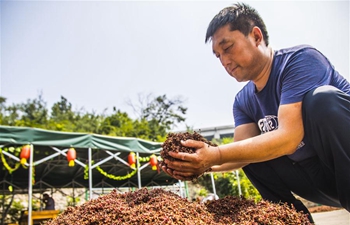
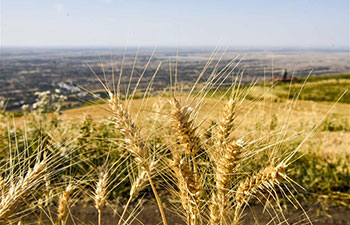
Researchers from University of California (UC), Berkeley found that well-established agricultural management practices such as planting cover crops, optimizing grazing and sowing legumes on rangelands, if instituted globally, could capture enough carbon from the atmosphere and store it in the soil to make a significant contribution to international global warming targets.
The study found that improved agricultural management could reduce global temperatures by 0.26 degrees Celsius by 2100, when combined with aggressive carbon emission reductions.
The Intergovernmental Panel on Climate Change's goal of limiting the average global temperature increase between now and the year 2100 is one degree Celsius or two degrees Celsius above temperatures before the industrial revolution.
"We found that there are a wide range of practices deployable on a large scale that could have a detectable worldwide impact. A big take-home message is that we know how to do this, it is achievable," said the paper's senior author Whendee Silver, a professor of environmental science, policy and management at UC Berkeley.
According to the study, by throwing in biochar, essentially charcoal, obtained by burning crop residue in an oxygen-free environment, these practices could offset even more warming, potentially as much as 0.46 degrees Celsius.
However, it is "is only achievable if you couple sequestration with aggressive emissions reduction," said Silver.
If carbon concentrations increase in the atmosphere, then sequestration becomes less effective at reducing temperature, according to the study.
Also, the researchers did not consider newer practices, such as composting, that are not studied as widely, nor did they consider the effect of improving soil on abandoned land, both of which could increase soil carbon sequestration even more.
"The point of our paper was to look at the temperature effect of implementing existing low-tech technologies already practiced within agriculture, in developing as well as developed countries," said Allegra Mayer, a UC Berkeley graduate student and the paper's lead author.