SHENYANG, Nov. 19 (Xinhua) -- Instead of roaring machinery and bustling workers, groups of tourists gather in the old factory of Anshan Iron and Steel Group to revive memories of the industrial age.
The former site in northeast China's Liaoning Province has been transformed into an industrial museum. Actually, a number of cities have been eyeing on creating cultural and creative parks, leisure and tourism areas and patriotic-themed bases with old industrial factors.
Less than 100 kilometers away from the city of Anshan, hundreds of old factories in Tiexi District of Shenyang, capital of Liaoning, were reinvented into industrial museums, cultural and creative industry parks or culture parks, which have become good destinations for recreation.
"Industrial heritage does not merely consist of cold steel and masonry. It carries the dedicated spirit and ideals of generations. The humanistic spirit embodied within it is what we call 'living soul,'" said Zhang Tinghao, former dean of the China Academy of Cultural Heritage.
The list of the first batch of 11 national industrial heritage sites was published in December 2017, and the second batch of industrial heritage evaluation work started at the end of March 2018, according to the Ministry of Industry and Information Technology (MIIT).
Sun Xing, deputy director of the industrial culture development center of MIIT, said archives were widely collected for national industrial heritage sites to improve research and protection work.
The old industrial base of Liaoning began to carry out industrial heritage investigations in 2003. Eight provincial industrial heritage sites have been selected as key cultural-relic preservation sites.
Apart from museums and patriotic education bases, industrial heritage has also been renovated into creative industrial parks, characteristic blocks and business tourism areas such as the famous 798 Art District in Beijing, according to Liu Lihua, associate professor with the School of Tourism and Hospitality Management in Shenyang Normal University.
However, the protection and utilization of industrial heritage in China remains at an elementary stage.
Wang Guoqing, chief planner of Liaoning urban and rural construction planning and design institute, said that a lack of stipulated regulations, norms and standards for protecting industrial heritage in China, ignorance of the deep cultural connotations and scientific value, and shortage of talent for integrating industrial culture and tourism could also weaken the influence of industrial heritage.
Zhong Jishou, secretary general of Architectural Society of China, said that the development and utilization of industrial heritage should not be separated from innovation and creativity. "Chinese cities should take its own path rather than blindly follow the modes of others," Zhong said.
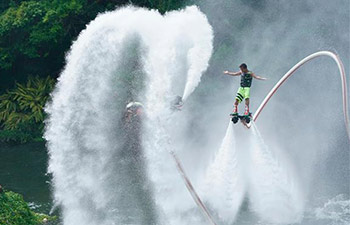
Last week, an underground quarry hotel opened in Shanghai Songjiang National Scenic Area. It was designed on the former site of the abandoned Xiaohengshan stone quarry -- a large pit with a depth of over 80 meters. The designer subtly created artificial waterfalls and lakes based on the original landscape, turning the city's "scar" into a wonder.
"Industrial heritage sites can be established as stadiums, nursing homes and training bases," Zhong said. "With its own cultural background and newly developed features, the industrial heritage will come alive in the future."