




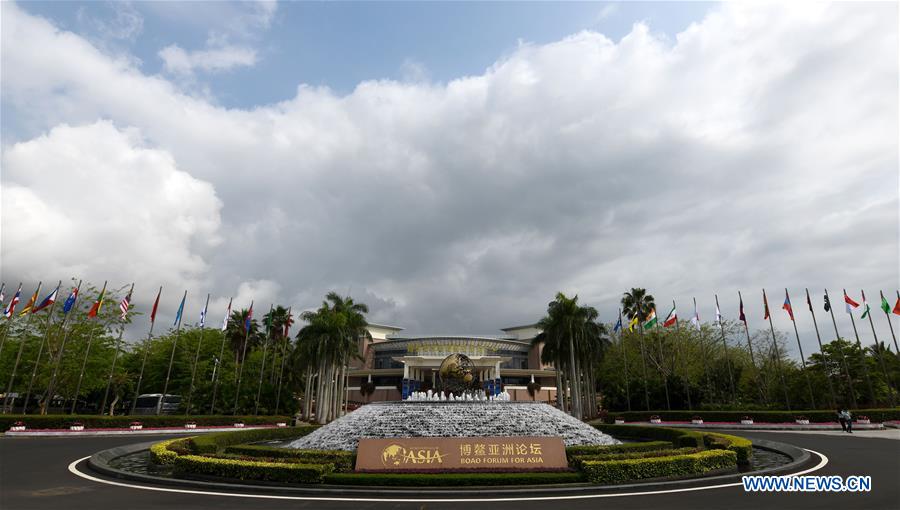
Photo taken on March 25, 2019 shows the International Conference Center in Boao Town of Qionghai City, south China's Hainan Province. The BFA annual conference will be held in Boao from March 26 to 29 under the theme of "Shared Future, Concerted Action, Common Development." (Xinhua/Yang Guanyu)
BOAO, China, March 26 (Xinhua) -- All eyes are once again on Boao, a coastal resort in China's southern island province of Hainan, as the annual Boao Forum for Asia (BFA) opened on Tuesday.
At last year's BFA meeting, Chinese President Xi Jinping vowed that China will only open its doors even wider. He also unveiled a broad set of bold reform and opening-up measures, seeking to infuse a dose of confidence and certainty into a wary international community that has been grappling with rising protectionism and isolationism.
One year on, China has delivered on its promise by increasing imports, broadening market access, improving the investment environment, and strengthening the protection of intellectual property rights.
To increase imports, China has cut tariffs for an array of products including automobiles, consumer products and medicine last year, lowering the overall tariff rate on imported goods from 9.8 percent to 7.5 percent.
It also held in Shanghai last November the first China International Import Expo (CIIE), which was attended by 172 countries, regions and international organizations and more than 3,600 enterprises. Intended deals worth 57.8 billion U.S. dollars were sealed at the expo. This year's import fair, according to China's Ministry of Commerce, is going to feature a larger exhibition area and be attended by more countries and enterprises.
To further level its domestic business playing field, China's national legislature adopted a foreign investment law earlier this month.
In January, the U.S. electric carmaker Tesla Inc. broke ground in Shanghai on its first overseas factory. The project also represents the first-ever solely foreign-invested one in the field of new energy automobiles.
Beijing, as pledged in this year's government work report, will further relax controls over market access, shorten the negative list for foreign investment and allow wholly foreign-funded enterprises to operate in more sectors.
The reason for Beijing to further its policy of reform and opening-up is simple: it has been the magic formula that has transformed China from a backward country into the world's second largest economy in 40 years. There is, therefore, no reason for Beijing to regress.
Another key factor for China's logic to further open up is that Beijing believes that such an approach can help countries worldwide better enjoy the bounties of China's development and thus boost their own development. As a result, China's growth will be further fueled in this age of growing global interconnection.
That is why China has proposed the Belt and Road Initiative (BRI) and invited nations around the world to join this open and inclusive endeavor.
Almost six years since its birth, the initiative, which aims to connect Asia, Europe and Africa through roads, railways and sea ports for a faster and easier flow of people, goods and capital to spur common development, has achieved substantial headway in terms of progress and popularity.
During Xi's ongoing three-nation Europe tour, Beijing and Rome signed a memorandum of understanding (MoU) on BRI cooperation, making Italy the first Group of Seven member to officially endorse the initiative.
So far, more than 150 countries and international organizations have signed BRI deals with China.
This year's BFA meeting falls under the theme of "Shared Future, Concerted Action, Common Development."
Despite its shortcomings, economic globalization has over the centuries brought the world's nations closer to each other than ever before. Coping with many of the new challenges facing the international community like climate change and terrorism needs global solutions.
Under such circumstances, to achieve common development and build a better world for all naturally requires nations around the world to choose cooperation and openness. By contrast, protectionism and isolationism provide only an economic sugar rush.
