By Zheng Xin, Yuan Mengchen, Dario Agnote
MANILA, May 28 (Xinhua) -- Walking down the street in Manila's China Town district, former Wushu champion Willy Wang is still easily recognized by many people. Barely a year after he won the gold medal in 2008 Beijing Wushu tournament, Wang retired in 2009 to spend more time with his family and business.
Wang, 36, now wears many hats. Aside from being a Wushu champion, he is also a martial arts master, a wushu international referee, a wholesale clothing supplier, and a real estate agent.
As a Filipino-Chinese born in southeastern China's Fujian province, Wang immigrated to the Philippines when he was a baby. At the age of nine, he started practicing Wushu with the aim of being stronger and healthier.
Large-scale China-Philippines Wushu exchanges began in the late 1980s. From then on, Chinese Wushu coaches have been sent to the Philippines to train aspiring Wushu artists like Wang. Coaches, who stayed in Manila for a year or two, not only taught Wang the skills of the sports but also the Mandarin language.
"I could barely speak Filipino and Hokkien at the time," he told Xinhua in an interview.
"Like my Mandarin, my Wushu style is mixed. A master taught me basic skills, another coach taught me Nanquan. A Taijiquan teacher taught me another," he said.
As an expert in Nanquan and Changquan, Wang won gold medals in the Ninth World Wushu tilt in 1997, the Southeast Asian Games in 2005 in Manila and 2007 in Thailand. But all of these pale in comparison to the gold he bagged in 2008 at the Beijing Olympic Sports Center Gymnasium.
The International Olympic Committee (IOC) gave special permission to the host city, Beijing, to organize the 2008 Wushu tournament parallel with the 2008 Olympic Games in order to showcase and promote traditional Chinese culture.
During the tournament, Wang bested 20 other competitors at the men's Nanquan & Nangun combined event in the Taolu category. Wang was the start of the Philippine Wushu team, which also hauled one gold, one silver and two bronze, a big win for the country.
Wushu is comprised of two components: Taolu and Sanda. Taolu involves martial art patterns, acrobatic movements and techniques for which competitors are judged and given points according to specific rules. Sanda, also known as Chinese boxing, combines full-contact kickboxing with close range and rapid successive punches and kicks.
"I can clearly remember that day August 22 when I won the gold, and my final point score was 19.44. I was so touched and excited when I saw the Philippine national flag raised on Chinese soil, where Wushu originated," he said.
But the gold medal was not an official Olympics gold. The Philippines has not won a "real" Olympic gold medal since the country attended the quadrennial multi-sport event in 1924.
"We enjoyed a hero's welcome when we arrived at the airport," Wang said. Inspired by Kung-Fu movie stars Jackie Chan and Jet Li, the Philippine Wushu team continues to win medals in world tournaments.
According to the Wushu Federation of the Philippines, Filipino athletes have so far hauled over 200 medals in its 30 years of competing in international Wushu competitions, in particular the Asian Games and Southeast Asian Games.
After his retirement from active competition in 2009, Wang said his career as a businessman gave him an entirely different perspective.
"The ultimate competition among Wushu athletes is related to culture. Even a little move or expression in your eyes during the performance contains Chinese traditions or manners, not just a posture," Wang said.
The "deepest concern" now, Wang said, is that there are fewer Chinese-Filipinos who are getting into the sport. "It will take time to train a new set of Filipino Wushu athletes with no background in the Chinese culture, and it will be costly to start all over again."
However, Wushu is a good way of teaching Filipinos understand more about Chinese culture, he explained.
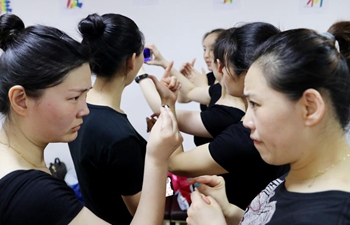
Six years ago, the Wushu Federation of the Philippines and the Philippine Department of Education signed an agreement to help Physical Education (PE) teachers in public schools learn Wushu, a selective PE course in the Philippines.
"The number of participating teachers is increasing," Wang said. For example, six years ago there were 30 teachers from central Philippine Iloilo City who registered to attend the five-day training course. But this year, he added that the number increased to 180.
"The rapid increase of PE teachers led to multiple increases of grass-root Wushu children in the whole country," he said.
Boxing, one of the most popular sports in the Philippines, has become a profession in this Southeast Asian country for nearly a century, and eight-division world boxing champion Manny Pacquiao is the country's living legend.
Wang expressed hope that one day the Philippines will also produce a Manny Pacquiao in Wushu sports.
"I think Filipinos will excel especially in Sanda because of their flexibility, resilience, and endurance. Just like Pacquiao, there will also be a Wushu champion in the future once future generations put in the hardwork," he concluded.